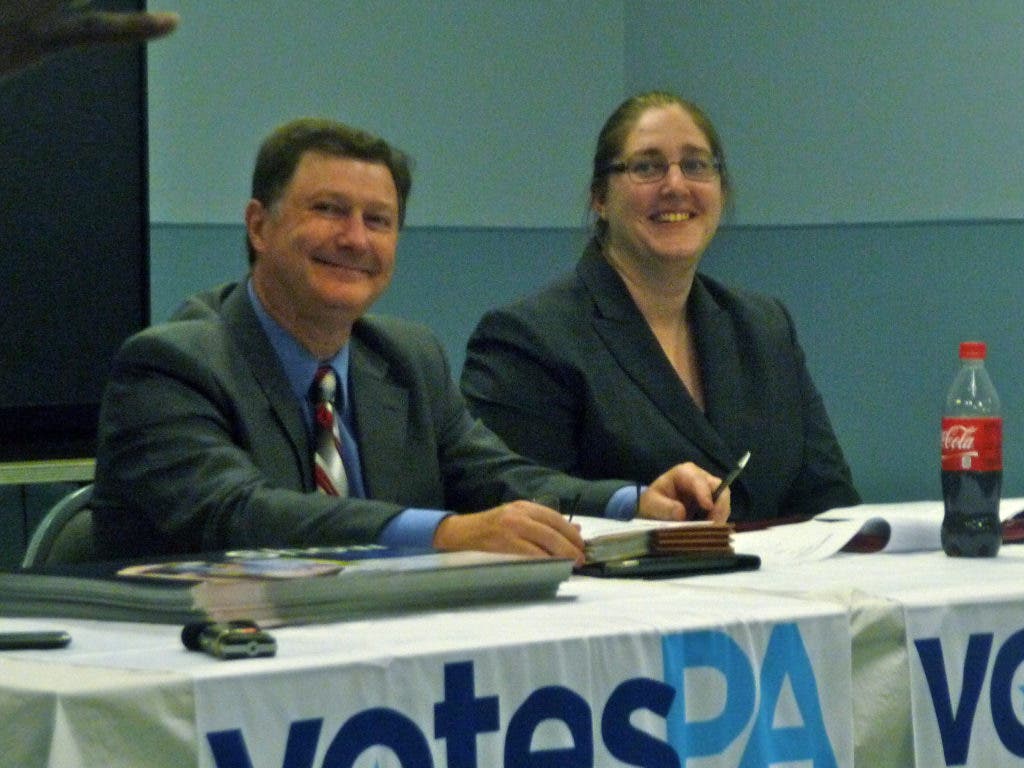
Though not happy about the new state law that requires voters to bring IDs to the polls, state Rep. Cherelle Parker (D-200) is trying to be proactive.
The chair for the Philadelphia Delegation in the state House of Representatives hosted a community meeting last week to get the FAQs answered and educate city and suburban leaders so they can spread info on the law.
"After the law was passed, while we're not pleased at all with it... we're dealing with it and need to know how to get prepared," Parker said.
Held at Laborers' Local #332 Union Hall at 13th and Wallace Streets, the August 1 midday meeting brought together other state representatives, media members, nonprofit association employees and city government staff to learn directly from the Department of State, the agency tasked to spread information the hall that impacts the 2012 election.
How the Law Works
The meeting's main objective was to outline how information will be shared—Parker was particularly insistent that the media plan is important. In addition, state officials provided voter guides in several different languages.
In essence, the law requires all voters to present either a valid photo government ID, or other state-sanctioned forms of identification—like IDs issued by public or private colleges, long-term nursing homes, assisted living centers, or personal care homes. Additionally the state will accept PennDOT IDs without photos for those with religious objections to being photographed; a drivers' license less than a year passed expiration; or military/veteran IDs without expiration dates.
The state will offer free IDs from PennDOT to those without a drivers' license.
Click here to visit the state's website, VotesPA.com, or here to .
How Word Will Spread
Representing the Department of State, Megan Sweeney outlined the ways Pennsylvania will spread word of the law. Using $5 million in federal money from the Help America Vote Act, the commonwealth plans to educate the 5.8 million registered voters through a variety of ways.
"Our two main objectives are to get info out there about the law, (in that) you have to bring an ID. And also to help get people those IDs," she said.
Through a media campaign, mailings and utilization of commonwealth services, Sweeney said, the Department of State will share the message. The state plans to run radio, TV and newspaper ads throughout the fall leading up to the election.
Sweeney summarized the many channels her office will utilize to get the word out. In essence, it's any means necessary. Some awareness plans include:
- Mailing postcards to all registered voters;
- Advertising on transit systems;
- Distributing info to all licensed PA care facilities;
- Increasing Department of State staff to field phone calls/answer emails;
- Reaching out to every college newspaper;
- Sending mass emails to commonwealth employees, public school superintendents and university presidents;
- Posting information on the crawl below all lottery television broadcasts;
- Using the voter website, plus Facebook and Twitter accounts; and
- Providing graphics for anyone who wants to directly link their website to VotesPA.com.
In addition, people can call 1-877-Votes-PA or read info here for detailed instructions on how to obtain an ID.
I'm not sure what you mean by "individual voting fraud" but if you meant to say in-person voter impersonation fraud, the Commonwealth admitted there is no evidence it happens: http://freeandequalpa.wordpress.com/2012/07/18/the-commonwealth-stipulation/ And how is flipping through a poll book to see whether dead people signed in to vote a "survey"? It would be a simple exercise. Prove that people are showing up at the polls on election day and impersonating dead people FIRST, and THEN spend my tax dollars on a law to fix the problem.
The Republicans are NOT behaving in a "civic minded way" as you say. They are behaving in a politically partisan motivated way. They are purposeful in their creation of this voter ID law to make sure that it targets those groups of American citizens that tend to vote for Democratic candidates and who supported President Obama in the last Presidential election. Why didn't the Republican's in PA make sure this law was in place before the Republican Primary? Who do they think they are fooling with the "test drive" of asking people during the primary for their ID's, but not requiring it? We even have the Republican politician on video stating that the voter ID law in PA will help Romney win the state. Is that what you call "civic minded?" Who is included in your "culture that does not trust government, does not value American Pride, and despises those that work hard and have success?" Who exactly are you talking about?
The system is so messed up ID seems trivial even tho I'm for it.
"Justices Antonin Scalia, Clarence Thomas and Samuel A. Alito Jr. concurred in the judgment of the court, but went further in rejecting the plaintiffs’ challenge. In an opinion by Justice Scalia, the three justices said, “The law should be upheld because its overall burden is minimal and justified.” "Indiana’s law allows voters who lack photo identification to cast a provisional ballot, then appear at their county courthouse within 10 days to show identification. Chief Justice Roberts, who grew up in Indiana, said during the argument of the case in January that such requirements are not onerous." http://www.nytimes.com/2008/04/29/washington/28cnd-scotus.html So the real issues to me are this, a) Can opponents to the photo ID provision really come up with anybody who can prove the law - on its own merits - causes anyone to be disenfranchised when the requirements of the law "are not onerous", and b) Given that a similar law has been ruled "minimal AND justified", how do they get around the obvious fact that with a bit of persistence - and in light of Pennsylvania's repeated attempts to make the law's requirements more "voter friendly" - no one should have a problem meeting its requirements? Sounds like a loser of an argument to me.
In a concurring opinion the authors are basically saying: "We agree with the result, but for reasons different than or in addition to the reasons the majority gives." So, for instance, in the healthcare opinion, the four more liberal justices wrote a concurring opinion saying that the individual mandate was a valid exercise of Congress' Commerce Clause authority (in addition to a valid exercise of Congress' taxing authority). That concurring opinion is, most certainly, not the law of the case -- it only had 4 votes. As for whether the Petitioners, unlike the voters who challenged the Indiana law, can demonstrate that the law will substantially burden or disenfranchise them -- they put on 14 witnesses at the trial to make that case. The transcripts of the trial testimony are here: http://www.aclupa.org/legal/legaldocket/applewhiteetalvcommonwealt/trialtranscripts.htm. Again, I am not going to even try to predict whether the Judge will find the evidence relevant and/or sufficient. But you can read the transcripts and form your own opinion.
Please tell us how the Republican voting law that targets specific groups of people, is Constitutional? Your statement of fear is very telling. There have been a few very dark times in the history of the world in which people, just like you, were willing to look the other way when other people were having their human rights, civil rights, god given rights, violated. Anyone that does not challenge these baseless "boogie man" laws created by the Republican Party members in Harrisburg are repeating a dark history and willing to ignore the Constitution of the United States of America.
All examination of these laws are pointing to the fact that the laws do and will PROHIBIT American citizens who are registered voters from voting. Examination of these new laws has also has cast a light on the fact that they are crafted specifically to target those American citizens that tend to vote for Democratic candidates. ANY American citizen that doesn't have a problem with a political party specifically crafting voting laws that "favor" as you say, one political party over another is not only disturbing, but also very dangerous as it undermines and threatens our democratic society. Brennan Center of Justice has criticized the voter ID laws, saying that it sees them as PROHIBITIVE Voting Laws that have the potential to impact the 2012 election. justwondering, you still haven't been able to answer the question as to how the PA laws are Constitutional. - You have stated that your "afraid of Democrats" yet you have no concern about laws that may very well be undermining the United States Constitution and the rights of select Americans. And, you clearly have no objections of a political party crafting laws in an effort to undermine the will of the people, for representation through their votes. - Like I said, the world has a very dark history of people who look the other way when a persons rights are oppressed.
The Pennsylvania Courts should also rule it so. Thirteen states require photo ID or alternative. Thirty states have various ID-at-the-poll requirements.
BTW ... There are indications that suburban white voters will be affected just as much as urban residents will be. (http://articles.philly.com/2012-07-30/news/32942988_1_voter-id-laws-marion-county-election-board-voter-fraud)
ps lets run over any bl...... I mean dem..........t who is going towards a voting booth!!!!!! DOG bless America...
It's Paul Ryan....not Ron Paul.....hahahahahahaha hahahahahahaha hahah you lose!!!!!!!
http://www.nytimes.com/1994/02/19/us/vote-fraud-ruling-shifts-pennsylvania-senate.html?pagewanted=all&src=pm The photo ID law would not have prevented the fraud at issue in the Marks case. So, yes, there are documented examples of "voting fraud" (absentee voting fraud, registration fraud, poll worker fraud, etc.) out there, but there are no examples of in-person voter impersonation fraud, which is why the Commonwealth was forced to stipulate it had no such evidence: http://freeandequalpa.wordpress.com/2012/07/18/the-commonwealth-stipulation/ This article sums up the issue: http://www.motherjones.com/kevin-drum/2012/08/repeat-after-me-person-person-person By the way, I would expect an expert in election law to actually know the name of the Marks lawsuit. Margaret Tartaglione (not "Tartagliana") was a defendant, but the case was Marks v. Stinson: http://scholar.google.com/scholar_case?q=19+F.3d+873+&hl=en&as_sdt=2,39&case=5071163011663898421&scilh=0
Don't cry foul if you don't have an ID, you have had a year to get one.